


Talk about your brandHow to Mix Modern and Traditional Furniture Well?
Last Updated: November 2, 2026
Quick Summary
Start by choosing one style to lead the room, then let the other support it with accents. Repeat three or four colors across pieces, and balance visual weight so no single item overwhelms its neighbors. Use this approach to learn how to mix modern and traditional furniture without a clashing result.
- Lead with modern or traditional, and let the other style serve as warm accents.
- Leave 14 to 18 inches between a sofa and a coffee table.
- Size the living room rug so the front legs of every seat rest on it.
- Keep the tallest piece traditional and the lowest piece mid-century.
- Repeat one finish, color, or shape at least twice across the room.
Table of Contents
- Start With a Clear Visual Direction for the Room
- How to Mix Antique and Modern Furniture Without Clashing
- Mixing Traditional and Mid-Century Modern Furniture Step by Step
- How to Make Mismatched Furniture Look Cohesive
- Booking a Design Consultation for Your Mixed-Style Room
- Frequently Asked Questions
Start With a Clear Visual Direction for the Room
Knowing how to mix modern and traditional furniture well starts with one decision: which style leads, because learning how to mix modern and traditional furniture depends on that choice. For a fuller guide to styling a luxury living room, see luxury living room styling.
Without a direction, a room tends to look like a collection of purchases. With one, every new piece has a place to go.
Choosing a Dominant Style
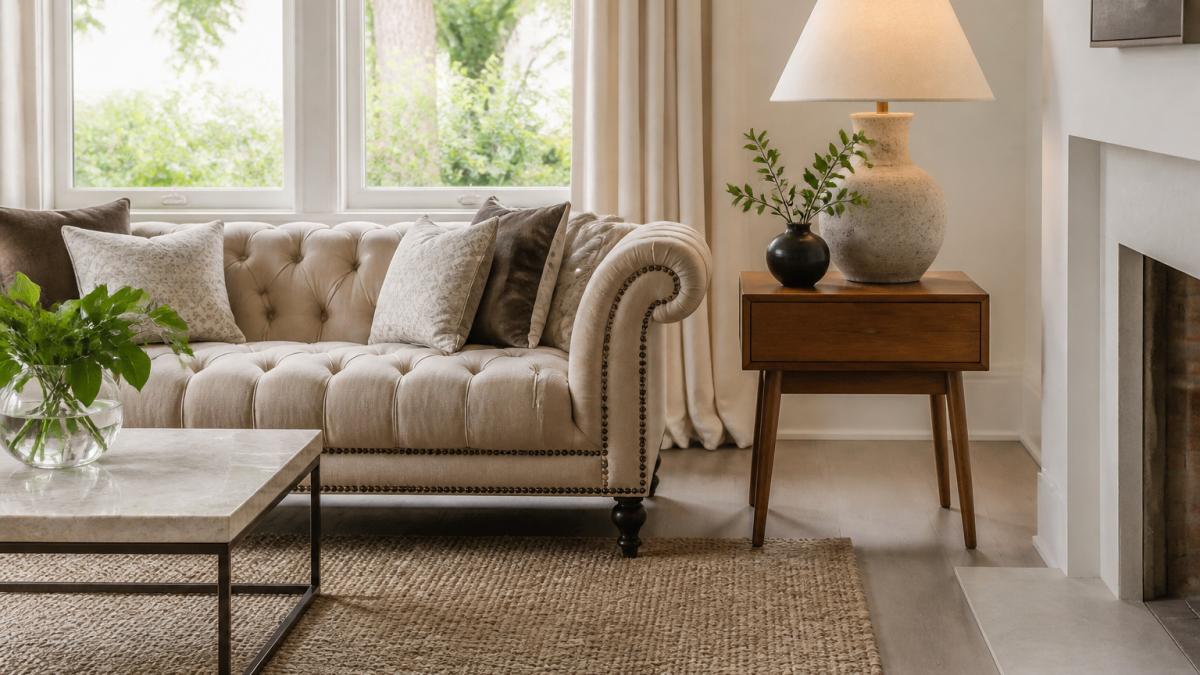
Pick one style to lead and let the other support it. Learn the elements of modern West Coast interior style to decide which should lead. A common approach works like this:
- Lead with modern for clean lines and open layouts, then add traditional pieces as warm accents
- Lead with traditional for formal rooms, then use modern pieces to lighten the feel
- Split the room in half only when the layout truly supports two zones
Building a Cohesive Color Palette
Repeat three or four colors across the room. Pull one tone from the largest piece, such as a sofa or rug, and echo it in a pillow, a lamp shade, or a side table finish. The Atelier Gray Oak Dining Table, for example, is finished in a charcoal gray oak veneer. Repetition is what makes mixed styles feel like one story.
How to Mix Antique and Modern Furniture Without Clashing
Antique pieces bring history, and modern pieces bring clean lines. To keep them from fighting, balance their visual weight. A heavy carved antique next to a thin-legged modern piece will feel off-balance. Place a solid antique chest beside a low, simple sofa, or pair a glass-topped modern table with an ornate antique chair.
Use the antique as the focal point and keep the modern pieces quiet. One statement antique in a plain room works better than three competing ones.
Mixing Traditional and Mid-Century Modern Furniture Step by Step
Mid-century modern and traditional furniture share good proportions, which makes them easier to combine than most people expect. The trick is to treat the pairing as a layout problem, not a shopping problem.
- Measure the room and mark the walkways. Note wall lengths, door swings, and the path between entries.
- Place the largest piece first and give it breathing room. This is usually the sofa or dining table. Leave 14 to 18 inches between a sofa and a coffee table, and 30 to 36 inches between a sofa and a fireplace or TV wall. A traditional sofa with rolled arms needs more clearance than a track-arm mid-century frame at the same seat width, because the arms add 6 to 10 inches on each side.
- Set the anchor with a traditional piece. Choose one traditional piece with visual weight, such as a wood chest, a wingback chair, or a formal dining table, and place it where the eye lands first. Keep the surrounding mid-century pieces lower or lighter so the anchor reads as intentional.
- Match height, not era. Pair a mid-century piece with a traditional piece whose back height or tabletop height is within a few inches. A 29-inch mid-century side table next to a 31-inch traditional chair arm looks deliberate; a 22-inch table next to the same chair looks like a mistake.
- Size the rug to the grouping. A living room rug should sit under the front legs of every seat in the conversation area, which usually means an 8-by-10 or 9-by-12 rug for a standard sofa-and-two-chairs layout. A rug that stops short of the front legs makes the mix look unanchored.
- Layer lighting last. Use one traditional lamp and one mid-century lamp at different heights to bridge the styles. The Travertine Table Lamp Benson ($2,795.00) is easy to place in both modern and traditional settings and sits on a tapered travertine base.
Watch out: placing a heavy traditional piece against a wall and floating all the mid-century pieces in the center splits the room into two camps. Pull one mid-century chair toward the traditional anchor so the styles share a zone.
Travertine Table Lamp Benson →
A Proportion Rule You Can Apply Today
Traditional furniture tends to be taller and deeper; mid-century furniture tends to be lower and lighter. When in doubt, keep the tallest piece in the room traditional and the lowest piece mid-century, then fill the middle with pieces that split the difference. This single rule prevents most scale clashes before you buy anything.
The article's step-by-step layout guidance is easier to scan in a quick reference:
| Step | What to do | Key measurement |
|---|---|---|
| 2. Place the largest piece | Leave clearance around the sofa | 14-18 in to coffee table; 30-36 in to fireplace or TV wall |
| 4. Match height, not era | Keep back or tabletop heights close | Within a few inches |
| 5. Size the rug | Rug sits under front legs of all seats | 8x10 or 9x12 for sofa-and-two-chairs |
| 6. Layer lighting last | Use one traditional and one mid-century lamp | Different heights |
How to Make Mismatched Furniture Look Cohesive
Mismatched pieces look cohesive when they share at least one element: a finish, a color, a material, or a shape. For guidance on choosing lasting luxury furniture that works together, see that guide. Before you buy anything new, diagnose the clash. Most mismatches fall into four categories, and each has a specific fix.
Diagnose the Clash First
- Scale clash: one piece is much taller, deeper, or heavier than its neighbors. Fix it by moving the heavy piece to a wall or corner and pairing it with a piece of similar height, or by adding a tall plant or floor lamp to bridge the height gap.
- Finish clash: warm wood sits next to cool gray metal with nothing between them. Fix it by repeating one finish at least twice in the room, or by introducing a third finish, such as brass, that reads as neutral between the two.
- Color clash: two strong colors compete with no shared tone. Fix it by pulling one color from the largest piece into a pillow, lamp shade, or rug border so the palette repeats.
Fixes That Work in Any Room
- Match metals within a zone. Pair brass lamps with brass or gold accents in the same seating area. Mixing brass and chrome is fine when they are in different zones, such as living room versus hallway.
- Repeat wood tones at least twice. A gray oak table can tie to light wood frames if the same tone appears on a shelf or chair. A single wood tone used once reads as an outlier.
- Use one unifying rug. A neutral rug under all the pieces pulls the grouping together. Size it so the front legs of every seat rest on it.
The Elliptical Glass Table Lamp Duco ($1,495.00) is equally at home in modern and traditional interiors, with an antique brass finish and a black marble base.
Room-by-Room Adjustments
- Living room: keep the mix to one traditional anchor and two or three modern supporting pieces. More than that and the room reads as a showroom.
- Bedroom: let the bed frame carry the traditional weight and keep nightstands and lighting modern and low-profile. Matching nightstand height to mattress height keeps the mix calm.
- Dining room: pair a traditional table with modern chairs, or the reverse, but keep all chairs identical. Mixed chairs around one table almost always look accidental.
Watch out: matching every wood tone exactly can make a mixed room look like a matched set from one catalog. Aim for two or three related tones, not one.
Booking a Design Consultation for Your Mixed-Style Room
Mixing styles well takes practice, and a designer can speed up the process. Eichholtz California offers interior design services from single-room edits to full residence projects, and design fees are credited toward final purchases. To understand how the remote design service works, step by step, read that overview. Plan your room's direction, palette, and key pieces before your first meeting so the time is well spent. Here is how to prepare for your interior design consultation.
Frequently Asked Questions
How do you mix modern and traditional furniture in one room?
Pick one dominant style so the room has a clear direction, then introduce the other style through a limited number of pieces. A traditional wood dining table can anchor a space that is otherwise modern, or a modern sofa can ground a room filled with antique accents. Repeat at least one finish, such as a warm wood tone or brass, across both styles so the pieces read as one family. Balance scale by pairing a heavy traditional piece with a lighter modern one of similar visual weight. Start with a few pieces and step back to assess before buying more.
Can you mix traditional furniture with mid-century modern pieces?
Yes. Traditional and mid-century modern pieces share a respect for quality materials and craftsmanship, which makes them easier to combine than they first appear. A classic upholstered armchair or an ornate wood console can sit comfortably beside a low-profile mid-century credenza if the color palette is consistent. Match the wood tones or metal finishes, keep the rug and lighting neutral, and avoid placing two highly ornate pieces side by side without a simpler piece between them to give the eye a rest.
What should be the focal point when mixing furniture styles?
Choose one statement piece as the focal point, usually the most visually striking item such as a classic sofa, a sculptural dining table or a large lighting fixture. Everything else in the room should support that piece rather than compete with it. Position other pieces so the focal point is visible from the entrance, and keep accessories and decor to a restrained number so the room has a clear point of attention.
How many styles should you mix in one room?
Two styles are usually enough for most rooms, with one dominant and one used as an accent. Introducing a third style increases the risk of a cluttered or disjointed look, though an experienced eye can sometimes carry it off with a strong palette. A practical rule is to keep the balance of pieces close to 70 percent from the dominant style and 30 percent from the secondary style, then use repeated colors and materials to unify the result.
Get started with Eichholtz California and turn a mix of pieces into one cohesive, curated space.
